
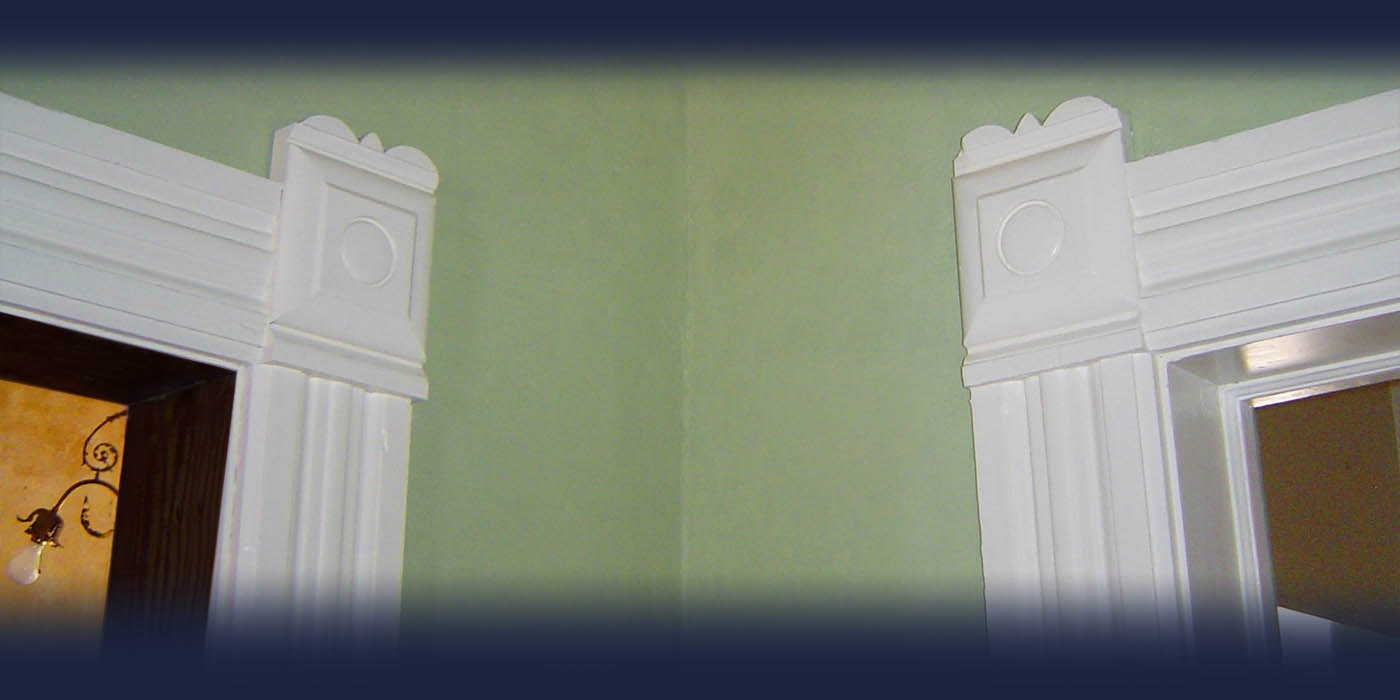
Plinth blocks, rosettes, and corner blocks are all important elements in the layered feel of Victorian architecture. When people think of Victorian door frames, most think of ornate design, but these Victorian elements are more than just decorative features. They have a very deep history, and in many cases they serve as the interface between competing architectural elements.
The plinth block (or plynth block) serves as a connection between the door casing and baseboard. Often the seam between the two can be very rough, especially with the expansion and contraction of wood over the years. The plinth block is designed to cover that seam by standing proud of both the door casing and the baseboard by 1/8” to ¼”, hence if the casing and baseboards are the traditional 7/8” thickness the plinth would be 1” to 1 1/8” thick. This provides the layering effect and hides any paint crack at the seams.
(Near Right): Blue Ox corner block for a house on M Street in Eureka. (Far Right): Three older wood plinth block patterns from our shop floor.
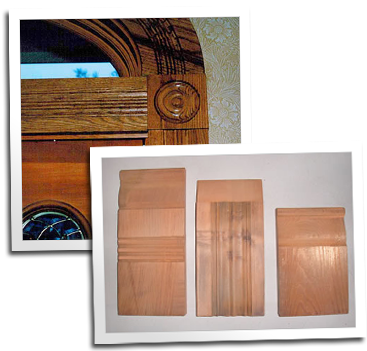
The easy way to make a plinth block is to run a board through a molder or shaper and then cut the board into multiple blocks, but that leaves the block with horizontal grain, and makes it more susceptible to chipping or shattering over the years as the end grain is now exposed to the traffic being at the edge of the blocks.
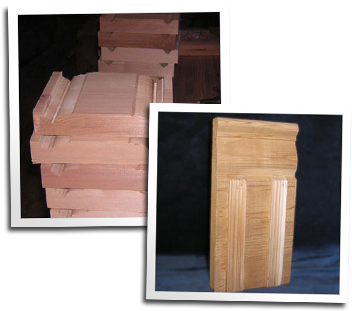
Our craftsmen are able to employ the correct method for manufacturing a plinth block, cutting each plinth block with the grain running vertically . Although more difficult this ensures that they will still be sturdy and strong well into the next century. This is especially important for stain grade products because it allows the strong vertical lines to continue from peak to floor.
(Far Left): Check out the direction of the grain on these authentic Blue Ox wooden plinth blocks. (Near Left): We experimented with the idea of a plinth block with raised flutes while doing a job for a customer in Boston. This sample was done with the cheaper horizontal grain method.
Corner blocks are found at the intersection between the vertical and horizontal casing trim of the door. Most modern homes directly join the vertical and horizontal with a mitered cut at a forty five degree angle. Unfortunately, even the slightest expansion and contraction of the wood causes the paint over the seam to crack.
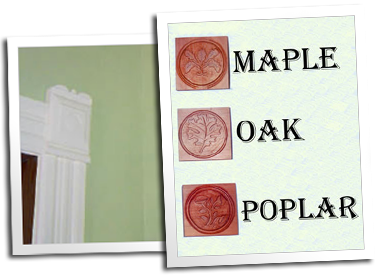
A corner block covers this intersection and adds a layered feel. As an added benefit, the seam between the corner block and the trim is in shadow so that attention is drawn away from the inevitable cracking in the paint. Most corner blocks contain decorative elements, usually a bulls eye pattern.
(Near Right): Replacement corner block for a home in Eureka, California. (Far Right) Maple, oak, and poplar pattern corner blocks made by the Blue Ox Millworks.
Whichever of these decorative elements you need for your home and business, Blue Ox Millworks will gladly put our over thirty years of experience to work for you. Whether in oak, cherry, redwood, walnut, maple or a wood of your choice, the Blue Ox team of expert craftsmen is ready to help. Contact the Blue Ox at (707) 444-3437 or send us an email for an estimate. View rosette pattern samples here.
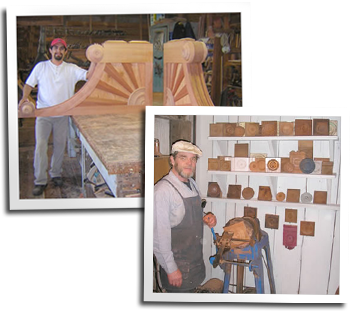
(Far Left) Two corbels with rosettes and a sunburst pattern are prepared for shipment to San Francisco. (Near Left) Just a few of the hundreds of rosette patterns that we have duplicated over the years.
While the information on this website is believed to be true and accurate at the date of publication, neither the authors, webmaster, nor Blue Ox Millworks can accept any legal responsibility for any errors or omissions that may have been made. Prices listed on website are subject to change. © . Blue Ox Millworks. All Rights Reserved. Web Design by DHD